Field
A card, and a piece of green string.
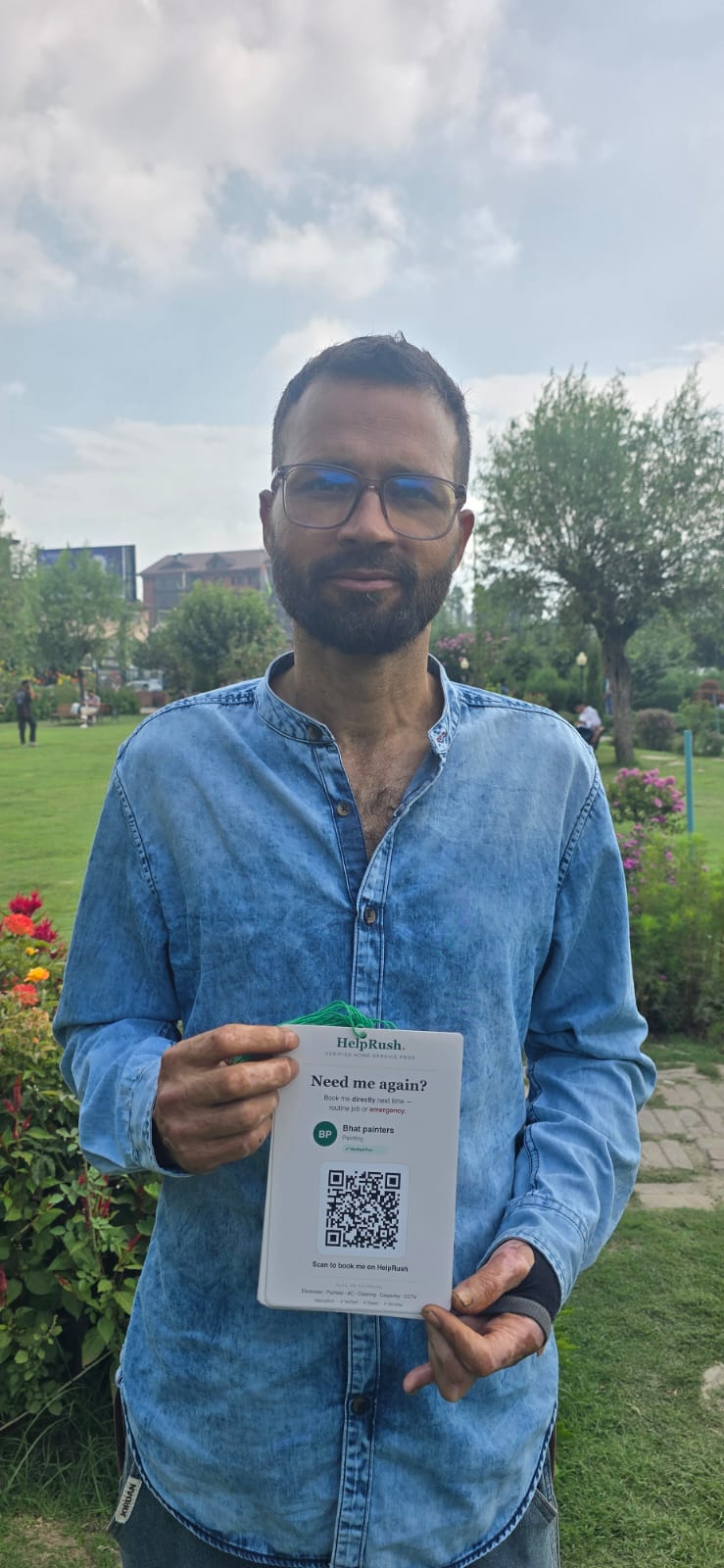
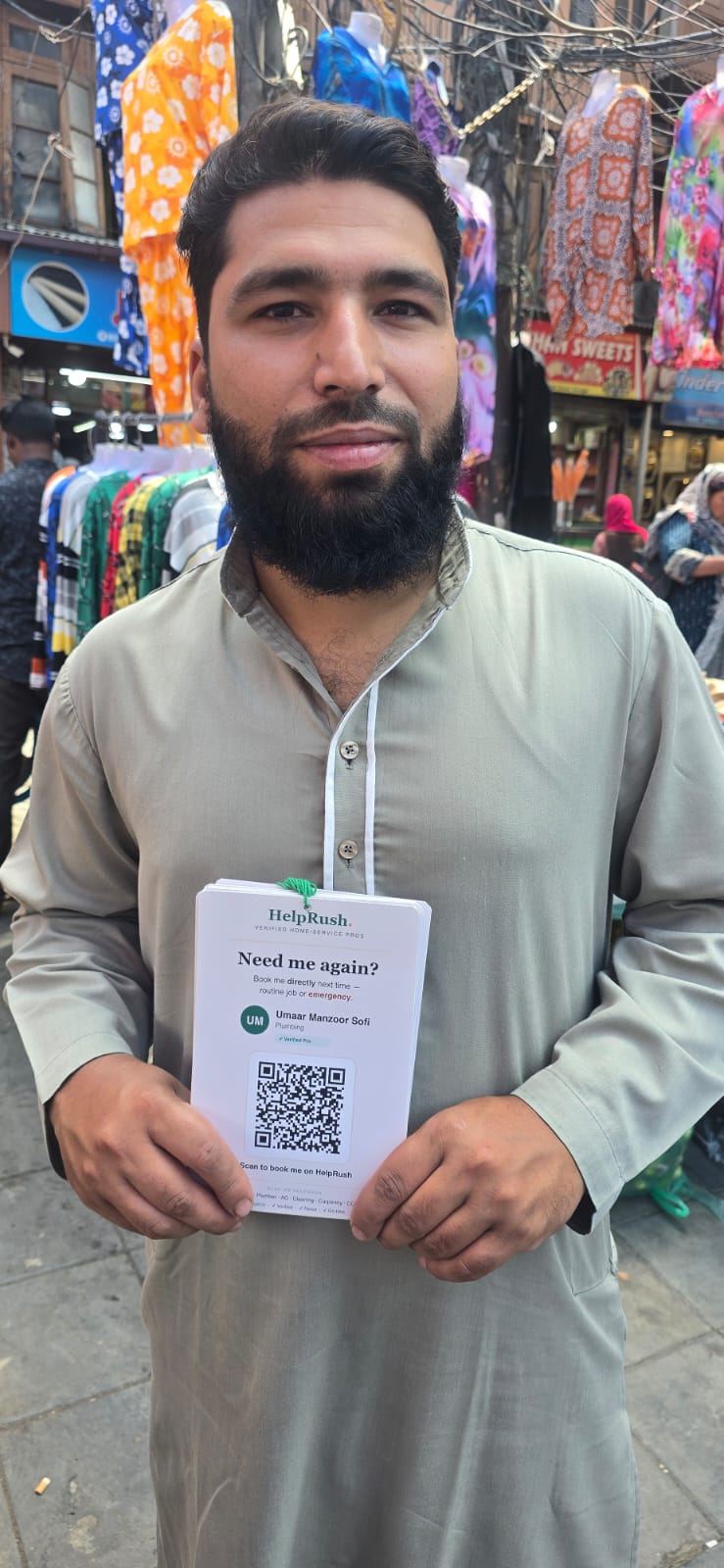
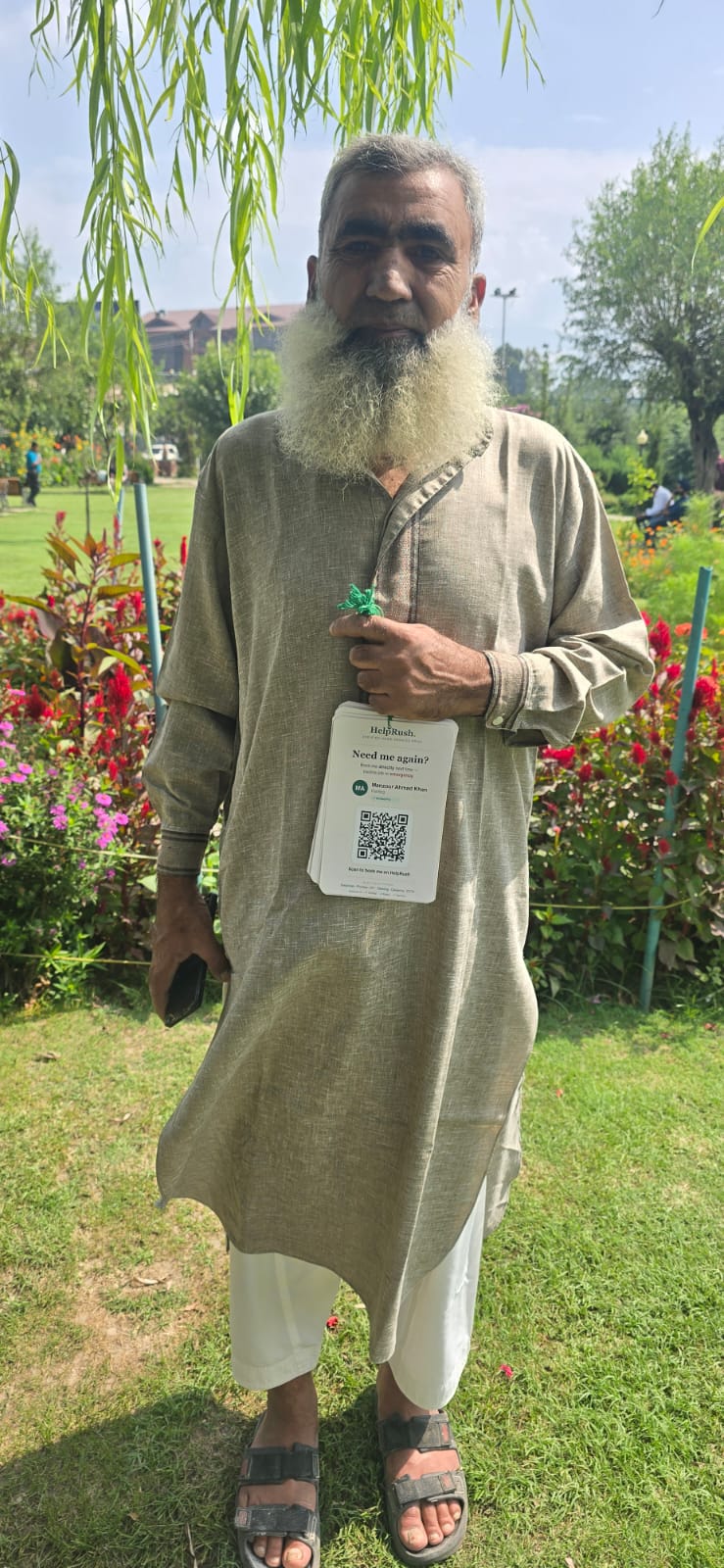
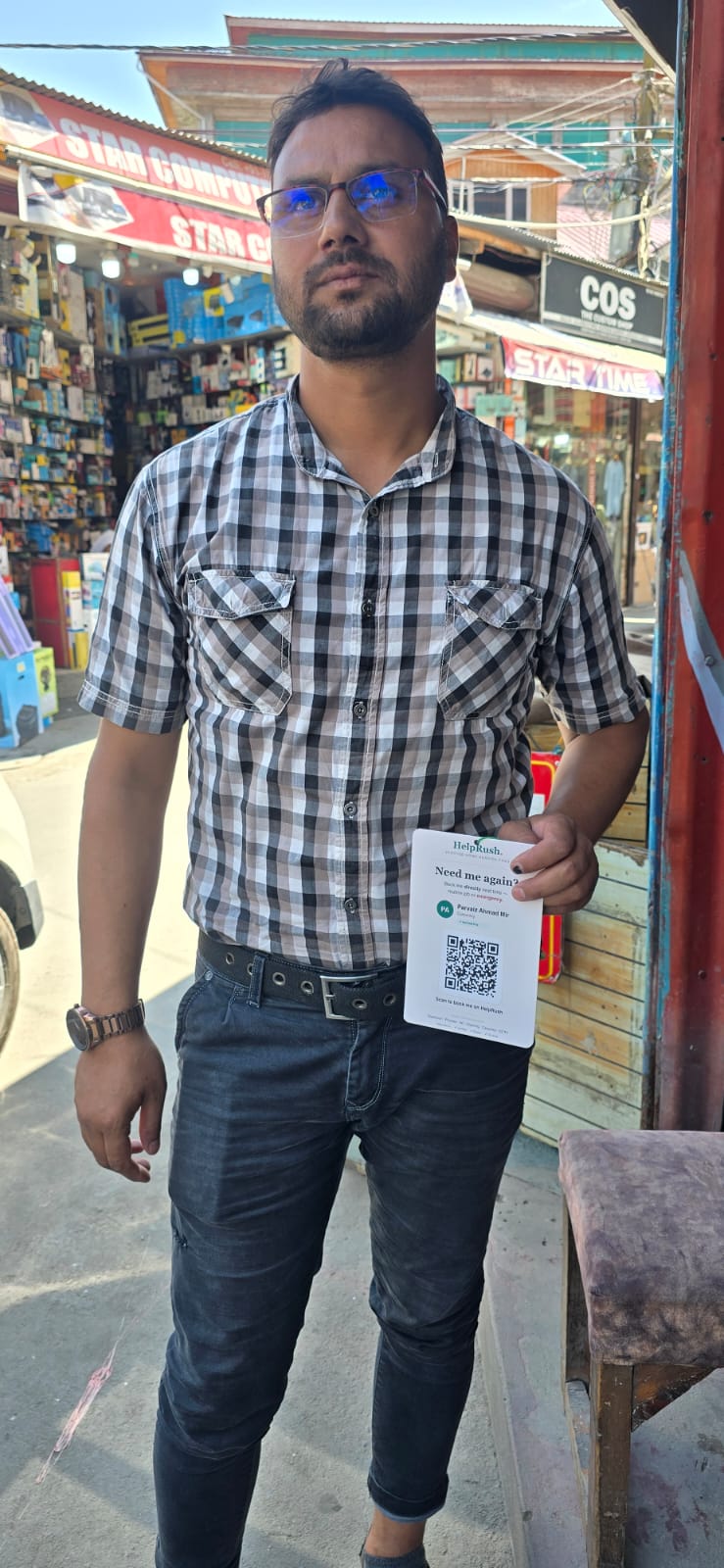
HelpRush has started putting printed cards into the hands of its verified pros — each one carrying a QR code to that pro's own booking link, and a loop of string, because a card you can hang gets kept. The customer scans it the next time something breaks. The job goes to that pro first. If he can't take it, another verified pro of the same trade does, in seconds. Notes from a card drive across Srinagar.
By Field Ops, HelpRush · 24 August 2026 · 4 min read
The thing a tradesperson in Srinagar has always been short of is not skill. It is the second phone call. A plumber fixes a leak in Rajbagh, does it well, and then waits to be remembered — a number scribbled on a gas bill, a name passed to a cousin, a card that goes into a drawer and is never seen again. Most of the work he will ever lose, he loses to forgetting.
So this month our ops team spent its days in parks and market lanes handing out cards. Not HelpRush cards. Each pro's own card, with his name on it, his trade under it, and a QR code that books him.
What happens when someone scans it
The code opens a booking already filled in — that pro, that trade, no menus. The job is offered to him first, ahead of everyone else, before general dispatch sees it at all.
Then the part that matters more. If he is up a ladder in Bemina, or asleep, or his phone is dead, the offer does not sit there going stale and it does not fail. It falls back into RushHour and goes out to every verified pro of the same trade nearby, widening until somebody takes it. The customer gets help either way. The card cannot become a dead end, because a card that dead-ends once is a card that comes off the wall.
That is the whole design in one line: pro first, platform always.
Why there is a string
A visiting card is a piece of paper that asks to be filed. A card with a loop of string through it asks to be hung — and in a Kashmiri house there is always a hook by the door, a nail in the lobby, a corner of the drawing room where the important things live. Electricity bills. A calendar. Now, a plumber.
That is the strategic bit hiding inside a piece of thread. Nobody downloads an app for a leak they do not yet have. But a card on the wall is already there at eleven at night in January when the pipe goes, and the distance between the problem and the help is one scan.
“We are not trying to be an app people open. We are trying to be the thing already hanging on the wall when something breaks.”
What the pro gets
₹101 for every customer who comes in on his card and completes a first job of ₹1,000 or more, up to ten of them. It is paid as wallet credit he can see and withdraw, not as a discount on our fee.
We considered the invisible version — quietly waiving our commission instead of paying cash — and rejected it. It costs the company the same and it is worth less to the person receiving it. A tradesperson who is owed something wants to see the number. So the two rails stay separate: commission is commission, the bounty is cash.
And if the customer who scans his card ends up booking him? He earns twice — once for the referral, once for the job. That is not a loophole we forgot to close. It is the point of the card.
The part we got wrong
For a while the cards worked and the credit did not. The printed code carried the pro's booking link but nothing that told our own system which pro had earned the introduction, so bookings arrived correctly and were attributed to nobody. Pros were bringing customers in and the ledger showed a flat zero.
That is fixed now, and the fix reads the card rather than anything printed on it — so every card already in a pocket or on a wall in Srinagar started earning the moment it shipped. Nothing had to be reprinted. It should not have taken a reprint-shaped scare to find it.
Where this is
Early. One city, a few hundred pros carrying cards, a bounty programme that has been live for days rather than months. We do not have a repeat-rate number worth quoting yet, and when we do it will go on our facts page with the sample size next to it.
But the shape is right. The pro grows his own repeat business and keeps it. The customer gets somebody they have already trusted once, or somebody verified in seconds if he cannot come. And HelpRush ends up where no advertising budget was ever going to put it — hanging on a nail in a drawing room in Srinagar, waiting.
Keep reading
Provider · 5 min read
The Super 30.
Thirty professionals in Srinagar have a five-star rating on every job they have ever completed, answer a job offer in under seven seconds, and reply to more than 85 percent of the offers they get. On Friday, 9 October, we brought them into the conference hall at Rangreth to honour them, finish their IDs, walk them through the Projects lane, and ask for one thing they could not give us. Notes from a long table.
Field · 4 min read
Friday at Pratap Park.
Every Friday our field team leaves the office and goes to wherever Srinagar's tradesmen are. On 4 September that was Pratap Park, on the Bund beside the Jhelum, with plumbers, masons, carpenters and technicians from across the city. They sat on the grass, learned the app one screen at a time, and walked out with an ID round the neck and a card that books them. Notes from the lawn.